Your store is listening to the wrong moment
Most commerce stacks only wake up when someone adds to cart. By then the interesting decision has already been made somewhere you weren't watching.
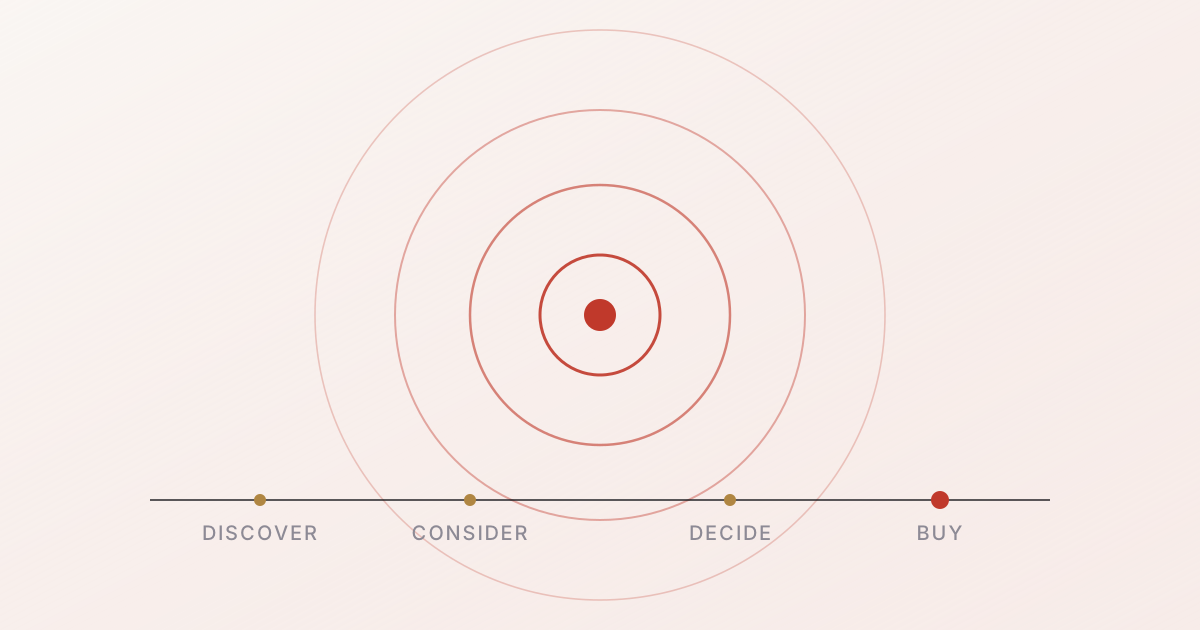
Think about the last thing you bought online that cost more than a coffee. The actual decision didn't happen at checkout. It happened earlier, in a stretch you probably can't even reconstruct. You compared two options. You read a review and discounted half of it. You left, came back the next day, hovered over the price, and talked yourself into it. Checkout was just the receipt for a decision you had already made.
Now look at how a typical e-commerce stack is built. It springs to life at the cart. Abandonment emails, retargeting pixels, discount popups, the whole apparatus is aimed at a moment that comes after the customer has mostly decided. We have built an enormous industry around reacting to the last five percent of the journey and ignoring the other ninety-five.
This is the gap that pulled me toward advising Commerzio. The premise is simple to state and hard to build: the signals that decide a purchase are happening continuously, in real time, and almost nobody is acting on them while they still matter.
Signals are not the same as data
Every D2C brand I talk to says they are data-rich. They have analytics, a customer data platform, dashboards, the lot. But data is a record of what already happened. A signal is something you can still act on. Scroll depth, hesitation on a price, the third visit to the same product page, the comparison between two SKUs: these are intent expressing itself in the present tense. Most platforms capture them, store them, and surface them in a report a week later, by which point they are history.
Ninety-five percent of buying intent shows up before the cart. Most stacks only start paying attention after it.
The reason isn't that teams don't care. It's architectural. A normal commerce stack is a dozen tools stitched together: the storefront, the CDP, search, email, retention, analytics, each from a different vendor, each with its own copy of the customer. By the time a signal travels across those seams, gets reconciled, and turns into an action, the moment is gone. You cannot do real-time orchestration on a foundation that takes hours to agree on who the customer even is.
One brain, not twelve tools
The shift I find genuinely interesting is structural, not cosmetic. Instead of bolting an AI feature onto each of the twelve tools, you collapse them around a single intelligence layer that sees every signal and decides what to do, in the moment, across every channel at once. One profile. One source of truth. One model scoring how ready this specific visitor is to buy, right now, and firing the right response before they leave.
When the architecture is unified, things that were impossible become routine. You can reorder a product grid for a hesitant first-time visitor and show a different one to someone clearly in decision mode. You can recover an abandoning cart in minutes, through the channel that person actually responds to, instead of a generic email three hours later. None of this is magic. It is what becomes possible when the system isn't spending all its energy reconciling itself.
Why this matters beyond commerce
I think the intent economy is a preview of a broader pattern. For a decade we optimized for collecting data. The next decade is about acting on it inside the window where action still changes the outcome. That is a much harder engineering problem and a much more valuable one. It rewards systems that are unified and fast over systems that are comprehensive and slow.
If you run a D2C brand, the question I'd sit with is uncomfortable but clarifying: of all the buying signals your customers generated this week, what fraction did you respond to while they still mattered? For most brands the honest answer is close to none. That is not a marketing problem you can spend your way out of. It is an architecture problem, and it is fixable.
I advise Commerzio, which is building commerce around real-time intent rather than the cart.
Explore Commerzio →